How Loud Should White Noise Be for Sleep? The Decibel Checklist
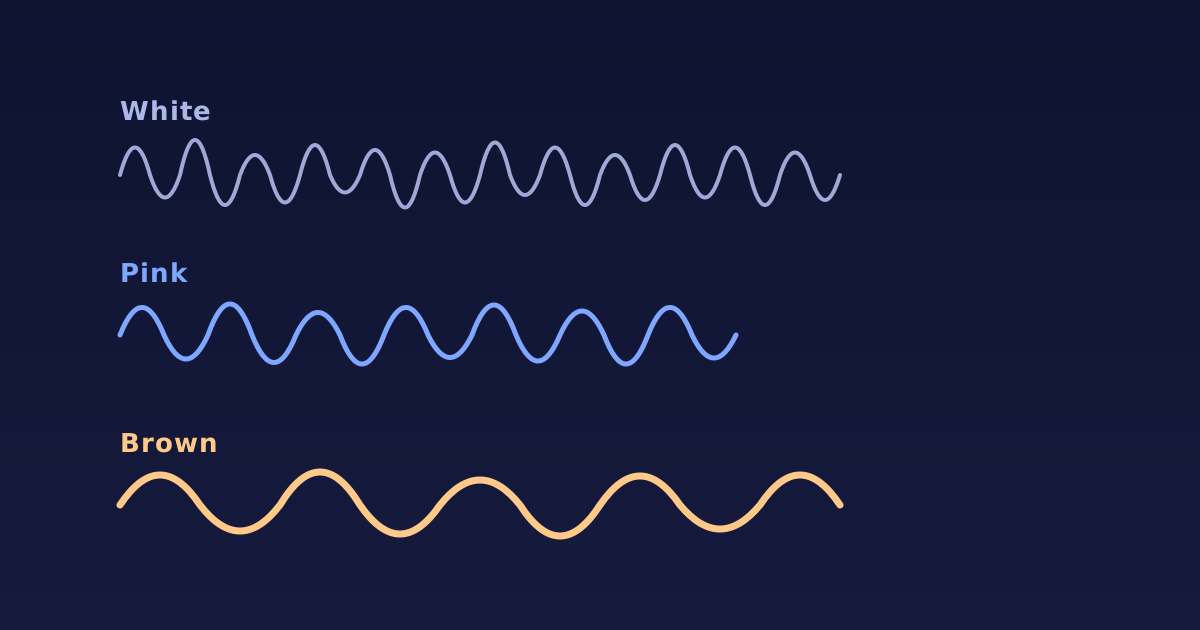
Anyone shopping for a sound machine eventually asks the same question: how loud should white noise be for sleep? There is no single official number, but research gives a workable range and a hard ceiling. This checklist breaks down the decibel targets, the danger zone, and the setup habits that keep white noise helpful instead of harmful for adults, babies, and children.
The Quick-Answer Checklist
- Target 50 to 60 decibels for most adult bedrooms. This range sits inside the 50-75 dB window that researchers used across sleep studies reviewed in a PMC occupational health analysis, where white noise in that band was linked to fewer nighttime awakenings and better sleep continuity, according to the occupational health review.
- Treat 70 decibels as a hard ceiling, not a goal. The Centers for Disease Control and Prevention flags sustained exposure at 70 decibels or higher, comparable to city traffic, as a risk factor for hearing damage over time, a threshold cited directly by the Sleep Foundation.
- Check what the machine can actually do before trusting the dial. Some consumer white noise machines can exceed 91 decibels at their maximum setting, which surpasses limits set by the National Institute for Occupational Safety and Health, according to research published on PubMed.
- Set volume relative to the room, not to a fixed preference. The right level covers existing background noise without adding extra loudness on top of it, a principle the Sleep Foundation's product guide uses when evaluating machines.
Why 70 Decibels Is the Line Not to Cross
There is no government-issued volume guideline written specifically for white noise machines, which is part of why so many people guess wrong. The Sleep Foundation notes that no official standard exists for setting white noise volume, but it points to the CDC's general noise-exposure research as the closest available benchmark. That research identifies 70 decibels, roughly the loudness of steady city traffic, as the point where regular exposure starts to carry real risk.
The mechanism is cumulative, not instant. Hearing damage from noise typically builds from repeated exposure over months or years rather than a single loud night, which is exactly why a white noise machine left running at high volume every night deserves more scrutiny than an occasional loud alarm. The Sleep Foundation specifically lists ringing in the ears and hearing loss as the two risks tied to regular exposure at or above that 70-decibel mark. Because a white noise machine plays for six to eight hours at a stretch, it accumulates exposure time much faster than a vacuum cleaner or a passing truck ever would.
What the Research Actually Measured
Sleep studies that use white noise as an intervention do not agree on one exact number, but they cluster in a predictable middle range. A systematic review of auditory stimulation and sleep found that among studies reporting sound intensity, levels ranged from 38 to 84 decibels, with an average around 55.55 decibels, according to PMC's systematic review. That average sits comfortably below the CDC's 70-decibel caution line.
Separately, the occupational health review found that white noise in the 50 to 75 decibel range produced measurable improvements in sleep and wake cycles across multiple studies, including reductions in nighttime awakenings, according to the PMC review. The overlap between these two bodies of research points to a practical sweet spot: roughly 50 to 60 decibels for most adults, with anything creeping toward 70 decibels treated as a signal to turn the dial back down rather than a comfortable ceiling to live at nightly.
Checklist: Setting Volume for Adult Bedrooms
- Measure the room before touching the machine. A free smartphone decibel meter app gives a rough baseline reading of how loud the bedroom already is from street noise, HVAC systems, or a partner's habits, which makes it easier to set white noise just above that baseline instead of guessing.
- Place the machine across the room, not on the nightstand. Sound intensity drops sharply with distance, so a unit sitting six feet away can be set at a lower dial position than one pressed directly against the pillow while still masking the same background noise.
- Start low and raise gradually. Beginning near the bottom of the volume range and increasing only until outside noise disappears keeps the setting anchored to actual need rather than to an arbitrary comfort level that creeps upward over weeks.
- Avoid wearing headphones or earbuds to play white noise overnight. Sound delivered directly into the ear canal removes the natural drop-off that distance provides, which the Sleep Foundation research on exposure risk suggests should be avoided for any sustained overnight sound source.
Checklist: Extra Caution for Babies and Children
- Keep infant sound machines at least seven feet from the crib. Because the 91-decibel maximum volume found on some consumer devices exceeds NIOSH exposure guidelines, according to PubMed research, distance is one of the simplest ways to reduce a baby's actual exposure without giving up the sound entirely.
- Favor the lower end of the 50 to 75 decibel range for nurseries. This mirrors the range used across the sleep studies summarized in the occupational health review, where white noise in that band was tied to fewer infant nighttime awakenings and improved sleep quality.
- Recognize that white noise works fast for infants, so loud is not necessary. One study cited by the Sleep Foundation found that 80% of very young infants fell asleep within five minutes of white noise exposure, compared with only 25% of infants without it, which suggests a moderate volume is doing the work rather than sheer loudness.
- Use a timer or auto-off feature when the device allows it. Running a machine only through the initial falling-asleep window, rather than at a constant volume all night, limits total exposure time for a child's developing hearing.
Placement and Device Type Change the Effective Loudness
The same dial setting can produce very different real-world loudness depending on where a machine sits and what kind of speaker it uses. A unit placed inside a crib or directly beside a pillow delivers far more sound energy to the ear than the same unit placed across the room, even though the volume knob has not moved.
The Sleep Foundation's product guide frames the goal simply: volume should be loud enough to cover existing noise pollution but not louder than that. This means the right setting is not a fixed number that works everywhere. A thin apartment wall with traffic noise on the other side needs a different setting than a quiet suburban nursery. Testing placement first, and only adjusting the dial after the machine is in its final spot, avoids the common mistake of setting volume high on a nightstand and then never re-checking it once the device gets moved farther away or closer to the bed.
When to see a professional
Persistent ringing in the ears, new sensitivity to everyday sounds, or a sense that hearing has become muffled after periods of nightly white noise use are signals worth raising with a clinician rather than managing through further volume adjustments. The Sleep Foundation lists both ringing in the ears and hearing loss as documented risks of regular exposure to sound at or above 70 decibels, and these are not symptoms to wait out. Parents who notice a baby startling less at loud sounds, or an older child asking to have the television or a person's voice turned up more often than before, should also treat that as a reason to seek professional evaluation rather than assuming it will resolve on its own. For more on the limits of this information, see the Medical Disclaimer.
Curious what a safe, personalized sleep and noise routine actually looks like night to night? Use SnoozeMetrics' free calculators to check sleep timing alongside sound habits.
Try the Sleep CalculatorsThis article is general information, not medical advice — see our Medical Disclaimer.